Beatrice Poblete Contributor
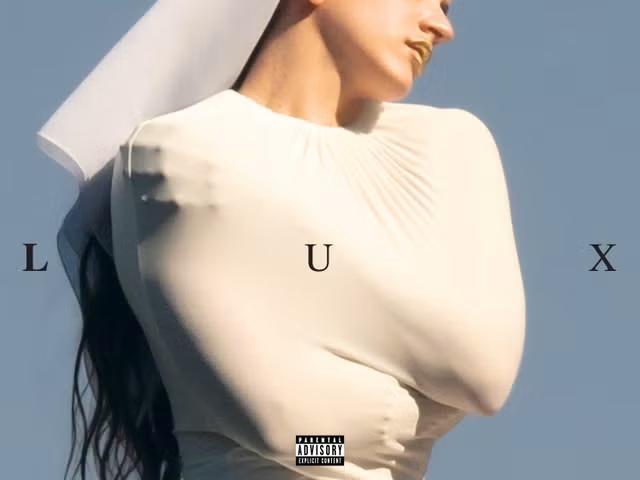
Art has always been a sacred human practice, synonymous with our expression, curiosity and discovery. Whether you are an artist or not, we all live in a world coloured by it. Music, poetry, movies, and dancing are all influences in our lives. But, now there is something that threatens the sanctity of human creation, artificial intelligence. AI is infiltrating our spaces, making it increasingly difficult for authenticity to thrive and I, like many others, have been unimpressed with AI slop, especially in the arts. However, I recently listened to an album that restored my faith in art. One so unique and imaginative that I have not stopped listening to it since it was released a couple weeks ago, Rosalía’s newest album, LUX. This album is stunning, sung in over 13 languages, created with the London Symphony Orchestra, and a dedication like no other. It is avant-garde with original sounds. But, what makes LUX so human? And why exactly does this album restore my faith in art? Well, let me tell you.
LUX is an album that explores the themes of femininity, death, sainthood, and love, very intimate aspects of life. Rosalía explores these themes through lyricism, but more importantly, by singing in the native languages of the cultures that inspired this body of work, including but not limited to Spanish, English, Japanese, German, Arabic and, even Italian. In her song “La Yugular”, she sings of one of Islam’s first sufi female saints, Rabia Al Adawiyya, a symbol of love. As a nod to Rabia and her story, she sings the chorus in Arabic. This is an ongoing pattern in other tracks such as “Porcelana” sung in Japanese or “De Madrugá” in Ukrainian–languages respective to its saints. She spent over two years of trial and error to pay tribute to these cultures. It is an homage to “love and curiosity — [of] wanting to understand the other better,” making LUX a conduit for connection and radical acceptance. The struggle of singing non-native languages, and still not being 100% fluent is as she describes “very much human.” Despite the challenges, Rosalía has never turned to AI, she is outspoken on how “It’s all human — very much human.” And frankly, curiosity and connection are what drive humans to make art. Making people feel seen or being moved even if you cannot understand. LUX, is the result of that desire.
On top of being sung in 13 languages, the album is a groundbreaking collaboration with the London Symphony Orchestra. Making the sound of the album classical with instruments like violins, flutes, pianos, cellos— strings, wood and percussion. But, simultaneously there are components of flamenco,opera, hip-hop and pop.
It is avant-garde and experimental, created through sheer authenticity. It is necessary to have records like this, that break the mould of generic pop beats and mediocrity. The concept behind this was that acoustic instruments give the album physicality, soul, and “the sense…that there’s a human in there.” When listening, it is evident that the goal has been achieved. The lead track, “Berghain” begins with dramatic strings and a quick tempo, immediately followed by an aggressive German chant and Rosalía’s powerful operatic voice. The violin is powerful, and accompanies her voice perfectly. The fifth track, “Mio Cristo Piange Diamanti” is a beautiful Italian opera. Her voice switches from powerful to soft, and the ending is a swell of instruments that you have a physical reaction to. But, it isn’t just orchestral music, influences of Flamenco are peppered in with songs like “La Rumba Del Perdón” with classic spanish guitar. The sound of this album moves you, because you can feel the passion behind every string played, every vocal and LUX is a journey of divinity, mortality, sainthood, and human experience. It, in my opinion, is what makes the album a masterpiece. It means something. Through her song “Reliquia,” she compares her heart and growth to religious relics scattered in different cities, a manifestation of internal conflict. “Magnolias,” my personal favourite, explores the concept of mortality. Rosalía sings about her funeral, who would show up, how everyone should rejoice and throw her magnolias while a choir sings. It is a beautiful song about facing the reality of death and observing it while you are still alive. It is what makes the album human, we can relate, we can understand.
Art is human, for our creation and consumption. While AI can produce soulless bodies of work, humans can create masterpieces. Rosalía’s LUX is purposefully human. It is born out of curiosity, connection and emotion, which are the most important components of artistry. LUX is sung in 13 different languages, composed with an orchestra of real humans, an album that delves into the human and divine. From the idea to the execution, LUX has left its mark on the music world. It is a rebellion in the age of AI and mediocrity. So, as a final answer to my question, if it wasn’t obvious enough, this album restored my faith in art because if someone can be compelled to create out of curiosity and devotion, there is no tolerating artists who do not go above and beyond for their craft. Rosalía’s work is proof where there is passion there is creation, and humans will always create.




Leave a Reply