George Thordarson Contributor
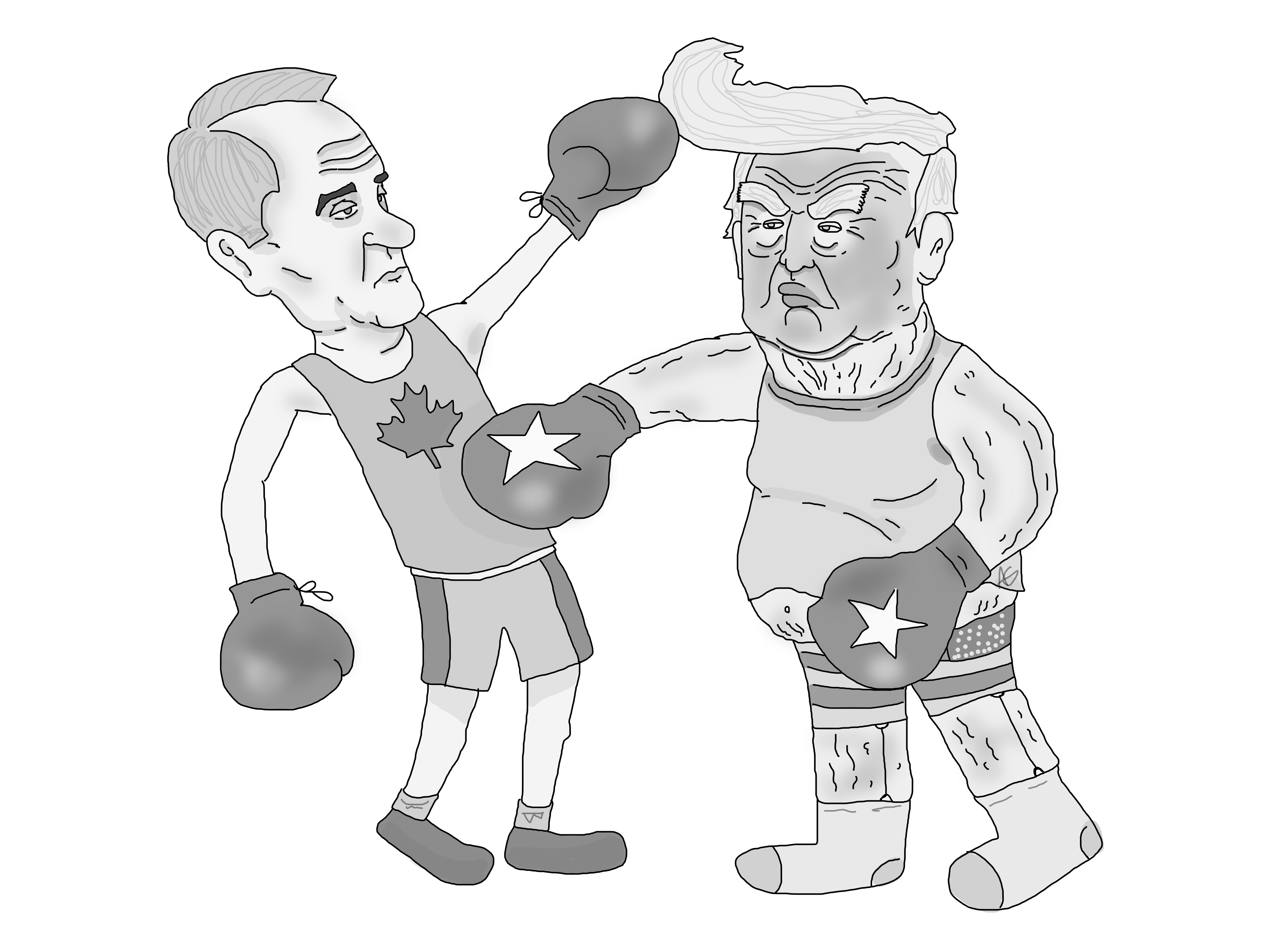
On January 20th, 2026, the Presidency of Donald Trump officially reached its quarter mark. It has been a busier-than-usual year for news coming out of our southern neighbour. From major domestic actions such as the ramping up of deportations by the Immigration and Customs Enforcement agency (frequently initialized as ICE), to the warm embrace of Trump rhetoric and style on all American institutions (including a notorious wall of Presidential plaques at the white house), it is hard to predict what the remaining 75% of the Trump term will bring: We are now living in an era of unpredictability from the government of the world’s largest economy.
But especially for Canadians watching this escapade, it seems that foreign policy has been the largest subject of this new Trump administration. In an effort to increase his own legacy, President Trump’s expansionist rhetoric has touched Cuba, Panama, Venezuela, Greenland, and our own country with persistent references to this idea of a 51st State. Given his love for tariffs, sudden action, and threats of annexation, it is hard to find Canadians who still trust the United States as a partner the way many of us did 13 months ago.
Speaking to a crowd of equally concerned European allies last Tuesday, Prime Minister Mark Carney marked the 1st anniversary of the Trump premiership by addressing the World Economic Forum (WEF) in Davos, Switzerland. Before he entered elected politics last year, the Prime Minister had addressed the forum on several occasions, and it is thus fitting that he chose this home court crowd to make one of the most important addresses by a Canadian Prime Minister in decades.
Carney repeatedly referenced a metaphor created by Czech revolutionary Vaclav Havel, drawing a synthesis between the state of the rules-based international order and the state of communism in Eastern Europe in the 1970s and 1980s. This is the idea of the performative expression: a system staying legitimate because everyday men and women pretend to believe in it. When one shopkeeper takes his “Workers of the world, unite!” sign out of his window, the system forms a crack that risks growing if another bold grocer follows suit.
Part of the PM’s speech was an acknowledgement that the idea that, since 1945, countries have been playing by the rules of the postwar international organizations was never actually true. Rather, countries like Canada have been putting the sign in the window: great powers like the United States may carve out violations and exceptions for themselves, but nonetheless, the hegemony that America created was economically advantageous for Canadians. Carney was saying what elected leaders rarely say: we simply cannot rely on great powers to play by the rules with anyone anymore.
Carney argued that great powers do not need to rely on others to build a strong economy. Strong internal markets and worldwide leverage mean that countries like China and the United States are not the most likely to suffer from degrading international institutions and partnerships. Instead, this international turning inwards puts middle powers at serious risk. How does a country like Canada weather this new chapter where American reliance is no longer an option? The Prime Minister sought to explain his plan.
First, there’s the need to build a stronger domestic economy. Carney emphasized his economic record during his brief tenure since leading the Liberals to a comeback last April. Measures to catapult investment seem to be the PM’s goal, and a focus on building a stronger economy is tied to sovereignty (especially for middle powers). A country that is less subject to the economic pressures of others is inherently more sovereign.
Second is the need to build partnerships in the name of “value-based realism” (a term coined by Finnish President Alexander Stubb and repeated by Carney in the address). Carney argued that the future of international partnerships is one where like-minded countries work on a more case-by-case basis. The central international bodies will lose even more influence (they are victims of the death of the rules-based international order), and instead, middle powers can seek to cooperate when prudent. Although Mr. Carney will no doubt continue negotiations with the Americans (and he also flew from China to Davos before this speech), he said in his speech that any negotiation between a middle power and a great power sees a middle power negotiating from a position of weakness. There’s a spirit of looking for the third way: find mutual views and band together.
International response to the speech was positive in coverage. However, Trump administration officials and President Trump himself have condemned the Prime Minister’s address. References to a 51st State have sprung up again this week, ranging from a Trump post showing Canada and Greenland covered by the American flag to Treasury Secretary Scott Bessent flaming Albertan separatism. It’s yet to be seen whether MAGA’s unhappiness at the address will impact long-term Carney-Trump relations, but Canada was also disinvited from the Trump plan for a multination board of peace.
Pierre Poilievre’s Conservatives have begun to slowly unify in their response to Carney’s Davos speech following an address by their own leader on Thursday. Their tone is one of praise in the overall direction, while critiquing a lack of action on major projects by the Liberal government. The goal is to connect the sovereignty argument to economic control: if a strong economy is essential for our independence, then should we not take faster action to take control of our resources?
Frankly, the Tories’ attack might break more ground if the government remains slow to start work on major projects. Of course, any action taken will never be enough for an opposition party, but their attacks might lose power if a pipeline project is approved in 2026. For now, Carney can appreciate his place in the sun: a well-written and intellectual monologue that charts the path forward for Western countries in the face of an unreliable United States. But if this speech kicks off another irrational Trumpian response, the Prime Minister’s victory lap may be cut short.


Leave a Reply