Nava Medikonda Contributor
Christopher Nolan’s newest film, The Odyssey, is a massive production that tells the tale of Homer’s epic poem about Odysseus’s long and troublesome journey home after the Trojan War, where he faces the consequences of the gods in epic proportions.
From David Lean’s Lawrence of Arabia to James Cameron’s Titanic and Peter Jackson’s The Lord of the Rings, few filmmakers throughout film history have had the privilege to tackle the epic genre, and quite to the proportions as Nolan has. The film tells a fictional tale from over 2,500 years ago, with Matt Damon in the front seat, and brings to life a spectacle crafted so precisely that it offers a cultural critique relevant today, with the humanism that follows war and destruction, that bears the question, “Was any of this really worth it?” This is the question Odysseus confronts after deep self-introspection, remembering who he is: a father, a king, a husband, a leader, and the man who faced the gods but never let that destroy him. A fair man who plucks his bow, which harps a beautiful sound before firing away to give the opponent a chance, “because it’s fair,” instead of a single-handed surprise attack.
Despite the film’s grand scale, it never shies away from illuminating Nolan’s greatest storytelling theme: going home. In his earlier work, Inception, the protagonist’s goal is simple: to return to the United States to reunite with his children. In Interstellar, the protagonist’s goal starts as a mission to salvage humanity through a brilliant and enduring space odyssey that turns into a heaping mission to reunite with his daughter Murph. In Dunkirk, the goal is to bring home troops waiting for rescue ships on the beaches of Dunkirk, as air support glides through the skies to defend the men who only dream of better days. It defines Nolan’s stamina and core narrative tenets: where is better than home? Nowhere.
While worthwhile, The Odyssey’s most compelling moments don’t seem to come from the strange series of events of Odysseus and his men on their journey home. These events include facing a Cyclops named Polyphemus, who then cries out to his father, the sea god Poseidon, causing the men to be punished and set off course for over a dozen years. Other events, even stranger and more fantastical, involve tall, knight-like figures on an island dressed in armour from the top down called Laestrygonians, who eat humans and lead to most of Odysseus’s men’s demise, a witch who turns humans into animals, a whirlpool that drags the crew into a time-sensitive life-or-death situation that demands precision to avoid its overwhelming, destructive current, a trip into Hades (aka the afterlife), and the sirens, a group of women mermaids who sing irresistible songs and secrets of the world, hidden truths, fulfilments, among much more.
The most compelling moments also don’t come from the eagerness and desperation for a new king to take the throne on the island of Ithaca while Odysseus is located across the sea, his whereabouts unknown.
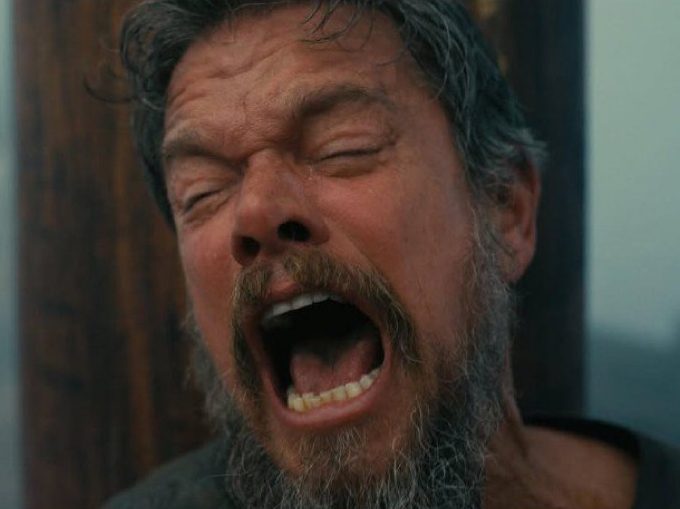
It is rather in the moments that reflect the shame that comes from a good person forced to make decisions in unforgiving circumstances. It asks us to tangle with the virtue of a good lie, and what that really tells us about the person saying it. Is it worth it if the lie makes someone else believe, or gives them some sense of hope? And what about telling the truth? Would that hurt even more? While it might be easy to tell a lie that seems harmless, the essence of it nevertheless blinds the other to a belief built on false premises and, ironically, fiction. These are the qualities and decisions a good leader must face; Matt Damon’s Odysseus portrays this troublesome conflict quite well, as the narrative untangles, allowing us to form our own opinions.
The Odyssey is a spectacle, an epic, but by no means a perfect film, and quite far from it. While it’s the first to be shot entirely on IMAX 70 millimetre film, setting a technological precedent that only Christopher Nolan is fiercely capable of achieving, it wouldn’t come as a shock to find out his next production is shot on top of the clouds, featuring a real Chinese celestial dragon, or deep beneath the pressuring sea next to a leviathan. Nolan’s imagination is triumphant, bending the rules and pushing the boundaries of our expectations, only capped by the cosmos and Zeus himself.
It’s hard to fault Nolan’s ambitious strides in an era of movies that feel unapologetically unambitious, though this year that’s changing: Obsession, Backrooms, Digger, Nirvana the Band the Show the Movie, The Invite, and many others — not perfect works, but can you smash them for trying to be?
While The Odyssey’s depth is packed to be deep, if you stand on your tippy toes, you can feel the floor lingering beneath your feet. It’s not the costume design at fault, or the polished-looking Trojan horse; it’s the payoff of the entire film.
Up until the last act, we are led to empathize with Odysseus and grieve his losses along his journey, though they never quite feel like losses, and the victory is barely sufficient for the buildup. We are led to believe each event is a massive weight being taken off Odysseus’s shoulders, though that’s hardly the case.
Despite this, the conflict in the 3rd act comes full circle to Zeus’ law to treat strangers and travellers with hospitality, because they may be gods in disguise, as we meet Odysseus in beggar’s clothing, set to battle for the throne of Ithaca in a wondrous fashion. While the film’s third act begins strong, I’m not necessarily satisfied with its conclusion. We just aren’t grieving hard enough nor feeling the spectacle this act is supposed to exhibit, apart from the masterfully designed sequence before Odysseus is revealed.
Adapting the entirety of a great work of noble literature into a single film is rather difficult, but Nolan makes it feel seamless, as with other adaptations. J.K. Rowling’s Harry Potter saga resulted in 8 films, each of which missed out on very intricate, small details within the wizarding world, though it nonetheless inspired a world of wizarding wonder. J.R.R. Tolkien’s The Lord of the Rings led to 3 films that omitted storylines and characters, but Middle-earth still felt like home. To encapsulate the sheer scale of Homer’s The Odyssey was never the goal, with the most notable omission being the Greek gods, who were almost entirely omitted from the film. Nolan clearly aspired to depict the inner conflict that a leader faces, one that is not just responsible for their own well-being, but for the others around them who look up to them for hope, words of wisdom, and a sense of honesty about their existence. A tale of fantastical proportions was sought to be delivered, and we got a fraction of it; suffice it to say, Nolan still brought us back home to the theatre, and one must congratulate the sheer dedication it took to do that.






Leave a Reply