Rosie McDonald Editor-in-Chief
Reporters
Rosie McDonald Editor-in-Chief
Arshad Saleh Managing Editor
Emily Neto Editor-at-Large
Chanuthi Gunaratna Senior Copy Editor
Aiden Fung Design Manager
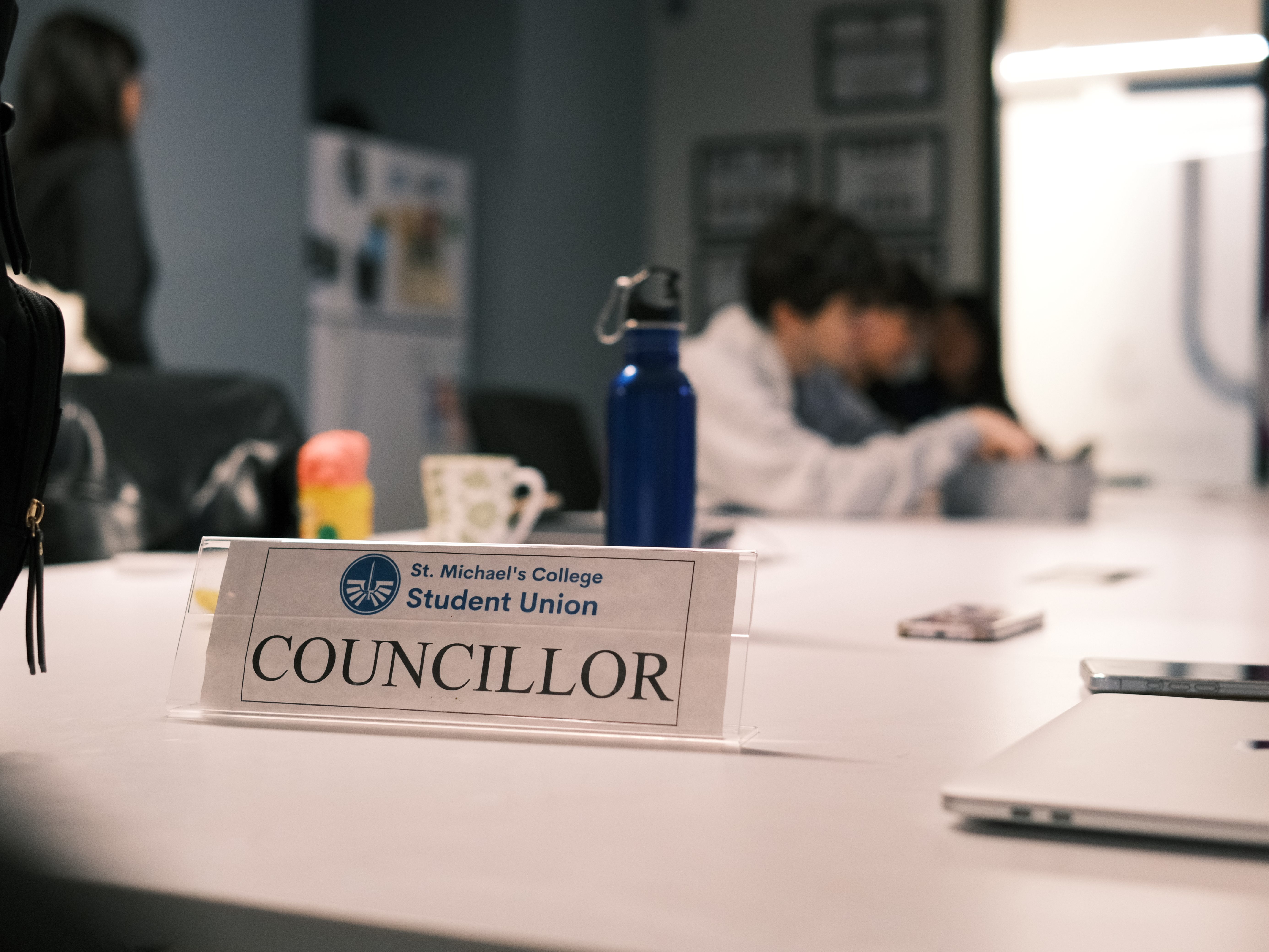
“It’s always been the people for me,” is how Alessandro Limanni, Vice President of the St. Michael’s College Students’ Union answered when asked what his favourite part of working on SMCSU is. On Tuesday October 6th, the St. Michael’s College Students’ Union dismissed Julia Zhu, Vice-President of Mental Health, in a blind vote held during an in-camera special meeting. The motion to dismiss the VP Mental Health passed with seven out of eight councillors voting in favour of the motion.
According to the SMCSU constitution, “a special meeting of the Council shall be called within seventy-two (72) hours once the Council is in receipt of an Application for Meeting, endorsed by a two-thirds (2/3) majority of Councillors, and attended by at least one half of the Councillors” (Article IV, Section 6, Subsection 5). The application for the special meeting was placed by the Vice President on Thursday October 1st at roughly 12:34 am to Jac Paraiso, President of SMCSU, who then disseminated the application to council members via email for the vote. Though the motion for the special meeting technically passed with five votes in favour and five abstentions, all five abstentions were the result of five council members failing to respond to the email motion, so a second motion for a special meeting was made during the regular weekly meeting on October 6th to give councillors a fair chance to respond. The motion once again passed, deciding that a special meeting would be held in place of the rest of the regular meeting.
According to the SMCSU constitution, “the Council or any of its subsidiary bodies may hold a meeting or part thereof in camera upon the Approval of Council. Motions arising while in camera shall be recorded in the minutes of the meeting” (Article III, Section 5). There was a motion for an in-camera meeting, which passed. Merriam-Webster defines the term “in-camera” as simply “in private.” For SMCSU’s purposes, that means everyone except council members and the elected chair must leave the room, including our reporter Aiden Fung, who was present for the regular SMCSU meeting that was originally going to be held as usual on that Tuesday from 5:00 pm to 7:00 pm. Additionally, the minutes of the in-camera meeting will not be published. It was later shared through multiple interviews with members of council that the special in-camera meeting was regarding Limanni’s Presentation for Grounds of Dismissal against Zhu.
Limanni and Zhu were asked to leave the room for the deliberation, which lasted over an hour and concluded with an almost-unanimous blind vote, seven out of eight councillors, in favour of the dismissal of Julia Zhu as the SMCSU VP of Mental Health. In a statement released by SMCSU on October 14th, it was stated that Julia Zhu violated the following constitutional articles:
- Article IV Section 2.1D
“Agree to model good citizenship and to engage in responsible and respectful conduct that reflects positively on USMC, USMC students, and the broader UofT and local communities.”
- Article VII Section 2.2B
“Failure to provide a safe and inclusive environment for all Members.”
- Article VII Section 2.2A
“Failure to comply with constitutional responsibilities as outlined in Article II, Article IV, and Article V, of their contract.”
In an interview with Zhu held on October 13th, she claimed that she had little to no prior knowledge of any grievances Limanni held against her until her receipt of the email for the application for the special meeting:
“I was very confused because the email that I got was the same email that all the other councillors got. I had no previous information or context… I read through the three things. All of them could fall under the same violation. And I didn’t know what it was. I had no idea what I was being called out for.”
She also questioned the choice of a special meeting for the motion against her, calling into question Article IV, Section 6, Subsection 5 of the constitution (see above):
“Only 5 people have to be there. And then how motioning in SMCSU works is the motion will pass if two-thirds of the council agrees with it. So if only 5 people show up for the special meeting, and Alessandro and I are non-voting members, that means 2 out of 3 people can just dismiss a counsellor, which didn’t seem like a good representation of the student body.”
Zhu also called Limanni’s timing into question, stating she “thought it was fishy that this was all done during the time when, Karina was absent because obviously she was gone September 30th to yesterday [October 12th].” The exact first date of Academic and Community Engagement Programs Lead Karina Stellato’s absence has also been alleged to be September 29th as opposed to September 30th as Zhu claims, the September 30th workday notably being hours before Limanni’s application was made on October 1st at roughly 12:30 am.
When asked if, in her opinion, the constitutional process was followed, Zhu answered:
“For the motions for the special meeting, no, not in the first email.”
She later went on to describe the specific events that transpired between her and Limanni that were allegedly cited by Limanni in the five minutes he was given to make his case to council before being asked to leave as a non-voting party:
“He said, Tuesday, September 1st, I yelled at him, and I swore at him, in a public setting. He also cited that, on Wednesday September 2nd, I approached him after being instructed to avoid contact… So he said on September 14th, 2026, I yelled and swore at him in a public setting. So, he, during the five minutes, went on to discuss that. I thought a good chunk of what he said just wasn’t true. And it seemed a little bit exaggerated.”
She also stated that she has apologized to Limanni:
“I apologized. I was like, ‘Hey, I’m so sorry I raised my voice at you. Stressful situation.’ And he was fully, very understanding. He was like, ‘No, it’s okay, don’t worry. I would have done the same if I was OC.’”
Zhu mentioned that she also had five minutes to make her case to council, which is consistent with SMCSU’s statement. Zhu also questioned why a grievance, “a formal complaint against a councillor or the council submitted by any member of the Union” (Article I, Section 1, Subsection 19) was not considered:
“I think, considering the violations that they said that I committed, a grievance procedure would have made more sense. So the difference between a grievance procedure and a dismissal is that a grievance procedure has to be filed within 15 days of the violation being committed and our sworn-in administrative advisor is the one that mediates all the conversations between both parties, and they try to find an active solution. Our sworn-in administrative advisor is Karina. Whereas a dismissal, it doesn’t have a timeline to it.”
Alessandro Limanni, when asked why grievance protocol was not followed, answered:
“I think there is a very big misunderstanding. A grievance does not serve as a step in between a dismissal. They are their two own distinct things. In fact, constitutionally speaking, a [dismissal] does not require a [grievance] in any situation… the dismissal process was followed. The grievance process is not involved in that.”
When asked about applying for the special meeting in the early days of Karina’s leave, he alleged that Karina had actually been updated in regards to the situation leading up to the application:
“This is not a decision that was made without her knowledge. In fact, I would sit here and say for the better half of the month, the administrative advisor was completely up to date with the situation. She was met with on more than multiple occasions to discuss this and discuss possible options, and, constitutionally speaking, if the administrative advisor is present, she can then send a delegate, in which case, a delegate was sent on her behalf. This delegate was informed of the entire situation from our administrative advisor, and, with that said, there is nothing on that end of things that I think would be unconstitutional in any way, shape or form.”
President of SMCSU, Jac Paraiso, was also interviewed. When asked why, in his opinion, the council elected for an in-camera meeting as opposed to a public meeting, he gave the following response:
“To pursue dialogue, you need to be able to say what you have to say, right? And that’s what in-camera is. It’s the final bastion that, if there are barriers preventing true dialogue, preventing people from giving their two cents, then in-camera is the mechanism to protect that.”
Vanecia Lai, Julia Zhu’s co-Orientation Coordinator with whom she worked alongside for multiple months earlier this year declined to comment or sit for an interview regarding Zhu’s dismissal. Ashley Yim, acting Programs Lead in Karina’s absence, and Emily VanBerkum-Farahat, Director of Residences and Student Operations, who was elected chair of the special meeting, did not respond to our requests for comment.
The St. Michael’s College Students’ Union’s constitution and statement regarding the dismissal of Julia Zhu are publicly available on http://www.usmcsu.ca. The St. Michael’s College Students’ Union will be holding an election to fill the role of Vice-President of Mental Health.



Leave a Reply